Montsalvat Wedding Photographer: Why It’s Melbourne’s Most Distinctive Wedding Venue
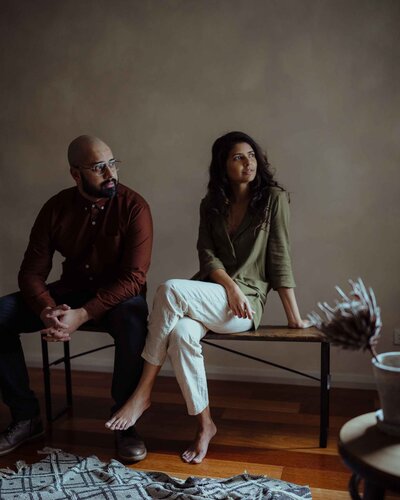
A note from a husband-and-wife duo who have lost count of the mud-brick walls we’ve photographed at Montsalvat. This is not a venue overview. It is what we tell couples planning their wedding at the colony when they ask us what to look for in a photographer.
If you have booked Montsalvat for your wedding, you have already made a particular decision.
You have chosen a hand-built artists’ colony, founded in 1934 by artist and architect Justus Jorgensen, listed on the Victorian Heritage Register, and built from mud-brick, rammed earth, and Victorian-era materials salvaged from buildings being demolished in Melbourne at the time. You have chosen the Great Hall with its vaulted ceilings, hand-cut timber beams, and original artwork by the founding artists. You have chosen the Bluestone Chapel with its significant stained-glass window, the French Heritage Courtyard, the ornamental pool, the wildflower garden paths, the peacocks moving freely between the buildings, and the fact that resident artists still live and work on the property today. Twelve acres in Eltham, in the foothills of the Yarra Valley, forty minutes from Melbourne CBD.
You chose well. Now the question is whether your photographer can see what you saw.
We have photographed weddings at Montsalvat across multiple seasons and most of its ceremony and reception configurations. It is one of our favourite Victorian venues, and one of the most demanding to photograph well, and those two things are connected. What follows is what we think couples planning a Montsalvat wedding should look for, ask, and pay attention to when hiring a photographer for this venue. The colony is not what most photographers’ visual references prepare them for, and the gallery you end up with depends on whether the photographer you hire understands that going in.
Why Montsalvat doesn’t photograph like other heritage venues
Montsalvat is often grouped with Werribee Park, Labassa Mansion, and Quat Quatta as one of Melbourne’s heritage wedding venues. The grouping is misleading.
Those other venues are restored grand buildings in the conventional heritage sense. Single architectural statements, formal interiors, polished surfaces, ballroom-scale reception rooms. The photographic vocabulary they ask for is grand, formal, often symmetrical. Wide chandeliered halls. Balustraded staircases. Tall sash windows with diffused light.
Montsalvat is none of these things.
It is a constructed European village in the Australian bush, made by hand from mud-brick, rammed earth, and reclaimed materials, lived in continuously by artists for ninety years, and home to working artists today. The Great Hall, for example, was built with materials salvaged from the Bijou Theatre and the Royal Insurance Building, among other Victorian-era buildings being demolished in Melbourne in the 1930s. The walls carry the irregularity of hand-construction. The timber beams were cut and placed by the people who lived under them. Original artworks by the founding artists hang in the spaces where they were made.
This matters because photographers trained on polished heritage venues reach for the wrong instincts here. They frame the architecture for grandeur where the architecture is asking to be framed for texture. They pose couples in front of walls because those walls look “heritage” without registering what makes the walls distinctive. They use the gardens as backdrop instead of using the gardens as character. The colony is doing different visual work than a restored mansion, and a photographer trained on the latter will produce a gallery that misses the former.
What Montsalvat rewards is a photographer who works with texture rather than grandeur, who understands that hand-built irregularity is the point rather than something to compose around, and who reads the colony as a layered environment rather than a sequence of pretty backdrops.
What to look for in a Montsalvat portfolio specifically
When you assess a photographer’s Montsalvat work, look past whether the images are appealing and ask harder questions.
Does the portfolio show the texture of the mud-brick walls, or does the post-processing smooth it out? Mud-brick has visible irregularity, warmth, and tonal variation that a photographer who works with the material highlights, and that a photographer who flattens everything to a polished editorial standard erases. If the brick looks like wallpaper in the images, the photographer has processed away the venue’s most distinctive surface.
Does the work move through the colony, or does it repeat three or four locations? Montsalvat has the Bluestone Chapel, the Great Hall interior and exterior, the French Heritage Courtyard, the Long Gallery, the Great Hall Forecourt, the ornamental pool, the wildflower garden paths, and the linking courtyards between buildings. A portfolio that returns to the same shots of the chapel exterior and the pool is doing less than the colony offers. A portfolio that finds the secondary spaces, the side stairwells, the timber doors, the smaller courtyards between the named ones, is being attentive.
Do the couples look like they belong inside the colony, or like they have been placed in front of it? This is the most telling distinction. Photographers who understand the venue produce frames where the couple is sitting inside an environment that has been lived in for ninety years. Photographers who treat the venue as backdrop produce frames where the couple could be standing in front of any wall, anywhere.
Is there evidence of working with available warm light? Montsalvat’s interiors are low-ceilinged, warm-toned, and the windows are set deep into thick walls. A photographer who responds with heavy flash sterilises the warmth and flattens the texture. A photographer who works with what is already there holds the warm cast as character rather than fighting it.
The specific photography challenges at Montsalvat, and what they reveal about a photographer
Each venue has a small number of conditions that separate experienced photographers from less experienced ones. At Montsalvat, there are four worth knowing about.
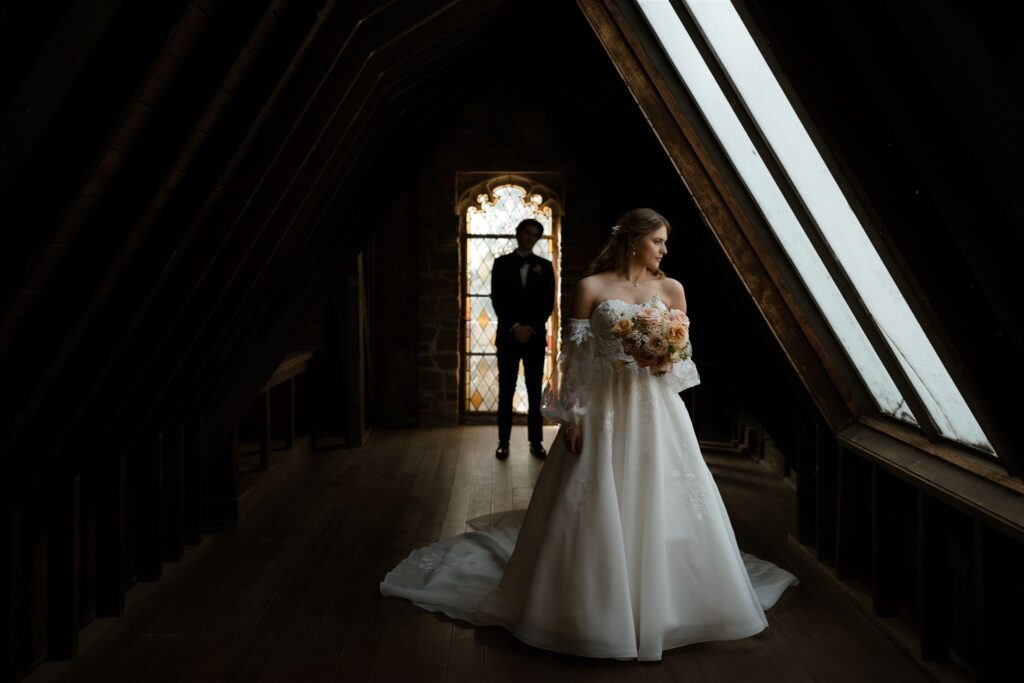
The Bluestone Chapel’s stained-glass light. The significant stained-glass window above the altar throws coloured light across the interior throughout a short ceremony, and the colour shifts as the sun moves. Photographers who do not know the chapel will be surprised by the colour cast on faces and will either fight it with flash or fail to account for it in their exposure. Photographers who know the chapel will have a plan for that light, including which side of the altar to position for the vow exchange and how to balance the coloured wash against natural skin tones. Ask any photographer how they handle the chapel’s stained-glass light. The quality of the answer is informative.
The Great Hall’s deep-window warmth. The Great Hall is lit during the day by sunlight filtering through windows set deep into thick mud-brick walls. The effect is small pockets of warm directional light against low ambient. This is challenging because the contrast range is wide and the warm cast is strong. Photographers who only shoot wide-open natural light will lose detail in the shadows. Photographers who blast flash will sterilise the room’s atmosphere. The work you want to see is a photographer who can hold the warm pockets and the shadow detail in the same frame, who uses minimal directional fill where it is needed, and who lets the Great Hall be the Great Hall.
The peacock factor. Montsalvat has resident peacocks and geese that move freely across the property. Couples often photograph alongside them by accident, and the best peacock moments cannot be staged. A photographer who has worked the colony has a peripheral awareness of where the peacocks tend to gather, when they are most likely to appear, and how to keep a camera ready for the unrepeatable frame. Photographers who treat the peacocks as a nuisance, or who do not notice them at all, miss what is often the single most distinctive image of the gallery.
The mud-brick courtyard transitions. A Montsalvat wedding moves the couple and the guests across multiple distinct environments within a short walk. Each transition is a photographic opportunity, and most photographers miss them because they are focused on the destination rather than the journey. The walk from the Bluestone Chapel through the French Heritage Courtyard, the moment when the couple steps from interior warmth into bright garden light, the brief crossing of the ornamental pool path. These are documentary frames that depend on the photographer being in the right place at the right moment, not on being told where to go.
The light at Montsalvat across a day, and what photographers consistently miss
Montsalvat’s light changes character across the course of a wedding day, and a photographer paying attention shapes the timeline around it. We work through it hour by hour.
Late morning, in the mud-brick courtyards. The courtyards catch their cleanest light when the sun is high enough to clear the building tops but before the contrast becomes punishing. This is the window for the first portraits of the bridal party against the hand-built walls, and for getting-ready coverage in the courtyards if the day’s flow allows it.
Early afternoon, in the Bluestone Chapel. The stained-glass window’s colour throw is most intense when the sun strikes it directly, which depends on the time of year. In summer, this can happen earlier than couples expect. In winter, it can be the only window when the chapel reaches full colour saturation. A photographer who has scouted the chapel across seasons will know when the colour is at its strongest and either plan the ceremony around it or accept the conditions of the season.
The hour before sunset, in the gardens and the ornamental pool area. This is the portrait window. The wildflower garden paths catch directional warm light. The ornamental pool throws reflective fill that softens the couple’s faces. The mud-brick courtyards take on a deep warmth they do not have at any other time of day. Photographers who default to the pool for reflection frames are doing the obvious. Photographers who use the courtyard walls as architectural counterweight to the soft sky are doing the richer work.
The Great Hall at dinner. Once the room is lit by candle and ambient, the Great Hall enters its strongest photographic register. The hand-cut timber beams, the original artwork, and the irregularities of the mud-brick walls all photograph richest under low warm light. A photographer paying attention shoots the speeches and the first dance with the room as character rather than background. The frames that hold up from a Great Hall reception are the ones where the architecture is doing visible work in the image.
After dark, in the colony’s outdoor spaces. Most weddings end inside the Great Hall, but the colony’s exterior environments, the courtyards, the chapel exterior, the pool area, take on a different character after dark that almost no one photographs. A confident photographer with a couple willing to step outside briefly produces frames that no other Montsalvat wedding has.
The questions worth asking any photographer you are considering for Montsalvat
How do you handle the stained-glass light in the Bluestone Chapel?
You are listening for a photographer who has thought about colour cast in mixed light, who understands that the chapel’s light shifts across a short ceremony, and who can articulate a specific approach rather than a generic answer about working with natural light.
What is your approach to the Great Hall’s interior during the reception?
You are listening for a photographer who can talk about warm-tone mixed lighting, low ambient with directional pockets, and how they balance flash and available light without overriding the room’s atmosphere. A photographer who defaults to flash for the whole reception will sterilise the Great Hall.
How do you handle the colony’s multiple distinct environments in a single day?
You are listening for a workflow answer. How they think about transitions, when they slow down to catch the in-between moments, how they pace the day so they are present at the unrepeatable frames rather than racing between the obvious ones.
Have you worked with the peacocks before?
A small question that reveals a great deal. A photographer who has shot Montsalvat will have a story. A photographer who has not will need a moment to consider the question.
How do you handle heritage-listing restrictions during the day?
The colony has restrictions on flash inside spaces containing original artwork, on equipment placement near heritage architecture, and on movement through certain areas during ceremonies. A photographer who has shot Montsalvat will know the restrictions without being briefed. A photographer who has not will be learning them on your wedding day.
Why coverage at Montsalvat is harder than at most venues
A Montsalvat wedding day asks more of a photographer’s coverage approach than most venues. Three things about the colony make this true, and they are worth thinking through whether you are hiring a solo photographer or a duo.
Your day moves across many small spaces. Most wedding venues compress the day into a few connected rooms. Montsalvat moves you and your guests across the Bluestone Chapel, the French Heritage Courtyard, the Long Gallery or Great Hall, the ornamental pool area, the wildflower gardens, and the linking courtyards between them. A single photographer running between these spaces loses real coverage time in transit. Two photographers working in parallel (the structure we use) can cover the chapel and the courtyard simultaneously, the ceremony and the guests arriving, the first dance and the candlelight along the Great Hall side walls, without choosing between moments.
Your light registers shift more than at most venues. A Montsalvat day moves between cool morning courtyard light, the stained-glass colour wash inside the chapel, hard exterior architectural shadows in the courtyards, the warm directional pockets of the Great Hall interior, soft golden light in the wildflower gardens, and candle-warm ambient during dinner. A photographer who can only hold one perspective at each handover will produce gaps in coverage. Two cameras working in parallel hold the moment from two angles at every shift.
The colony rewards documentary attention to the quiet, overlooked moments. Montsalvat is a place where the most distinctive frames happen in the periphery. A peacock crossing the path behind you. A guest pausing in a side courtyard. A resident artist’s door slightly ajar. Original light slanting across a mud-brick wall that has been there since 1934. These moments happen in parallel with the obvious ones, which means a single photographer has to choose which to capture and which to miss. Two photographers can hold both.
If you are hiring a single photographer for Montsalvat, ask them how they handle the colony’s peripheral moments. If you are hiring a duo, ask how the two cameras coordinate across the colony’s many small spaces. Either answer should be specific.
Frequently Asked Questions About Weddings at Montsalvat
Where is Montsalvat and how do guests get there?
Montsalvat is located in Eltham, Victoria, in the foothills of the Yarra Valley, approximately twenty-five kilometres north-east of Melbourne CBD. The drive from central Melbourne takes around forty minutes outside peak hours, with on-site parking available. The location is further than most inner-city heritage venues, and worth factoring into transport planning for guests travelling without a car. Eltham sits on the Hurstbridge train line for guests using public transport, and rideshare services operate to and from the colony.
What’s the best time of day to be photographed at Montsalvat?
The best photographic windows at Montsalvat are the hour before sunset across the gardens and ornamental pool, the early afternoon when the Bluestone Chapel’s stained-glass window throws its strongest colour wash, and the candlelit hours inside the Great Hall during dinner. Late morning courtyard light is the cleanest of the day for bridal party portraits. After dark, the colony’s exterior spaces, the courtyards and the chapel exterior, produce frames that almost no Montsalvat gallery includes, and we recommend stepping outside briefly during the reception if the day’s flow allows it.
How many guests can Montsalvat accommodate, and what spaces work at different scales?
Montsalvat has a forty-guest minimum for catered packages and supports weddings up to approximately 250 guests. The Bluestone Chapel seats forty for an intimate ceremony. The Great Hall seats 108 for a formal dinner and is the most common reception space. The Long Gallery holds 160 for ceremony or canapés. The Barn Gallery seats 170 for dinner and accommodates 250 cocktail-style. Different combinations of spaces work at different scales. A sixty-guest wedding might use the Bluestone Chapel for the ceremony and the Great Hall for reception. A two-hundred-guest wedding would more likely move through the Long Gallery and into the Barn Gallery.
How far in advance should I book a photographer for a Montsalvat wedding?
Montsalvat books out for popular dates twelve to eighteen months in advance, and the most sought-after photographers at the venue follow a similar booking pattern. If you have a confirmed Montsalvat date, begin photographer conversations as soon as possible. Autumn and spring Saturdays move fastest, as the colony’s gardens are at their visual peak in those seasons. We typically recommend reaching out at least twelve months ahead for peak-season weddings.
What’s your approach to photographing weddings at Montsalvat?
Our approach to Montsalvat starts with the texture. We treat the colony as a hand-built environment to work inside rather than a sequence of backdrops to pose in front of, which means our portraits put couples into the warmth of the mud-brick walls, the colour wash of the stained-glass chapel, and the lived-in quality of the courtyards. We work as a husband-and-wife duo with two cameras across the entire day, which lets us cover the colony’s many small spaces simultaneously and follow the peripheral moments, the peacocks, the resident artists’ doors, the guests pausing in side courtyards, that produce the most distinctive frames. Our storytelling style leans toward the candid and the cinematic rather than the heavily directed, which suits a venue that has been hand-built and lived in for ninety years.
If you are planning a wedding at Montsalvat and want photography that honours the hand-built character of the venue and the specific day you are creating, we would love to hear from you.
You can enquire here,

capture your wedding day through the eyes of an artist.
Helllo, we’re the Berhardts, a husband-and-wife wedding photography duo calling for a renaissance in modern-day love stories.
Our storytelling style of wedding photography captures the quiet, overlooked moments and transforms them into something cinematic. We embrace the authentic, raw and candid moments–where the true beauty of your love lies.
as a married couple, we've been on the other side and know how important it is to capture those moments we all too quickly forget. Having two photographers also allows us to capture the magic of each moment from many angles, to tell your love story.
Let's Talk